

Reducing insecticide use by two-thirds, and moving from broad-spectrum agrichemicals to more targeted products are changes kūmara grower Luke Posthuma has experienced since introducing biodiversity planting into his farm system.
Luke is one of a number of vegetable growers around New Zealand trialling biodiversity planting to support pest management as part of extension of the Vegetables New Zealand-Onions New Zealand-A Lighter Touch biodiversity project.
Last month Luke hosted a field walk at his Dargaville farm, sharing his experience from two years of trialling biodiversity planting at his farm, in the form of annual flower strips. Further events were hosted by growers in Nelson, Levin and Hawke’s Bay on March 17, 18 and 19.
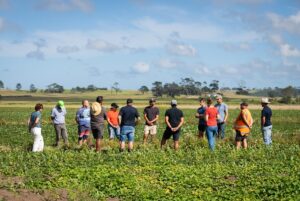
Dargaville kūmara grower Luke Posthuma hosts growers in a paddock with an annual flowering strip in bloom.
Luke says on his farm incorporating biodiversity planting has “helped us move towards better insecticide management, including better insecticide practices and reducing our total application.”
By incorporating biodiversity into the farm system, the goal is to enhance beneficial populations, leading to fewer insect pests in crops, and less insecticides required.
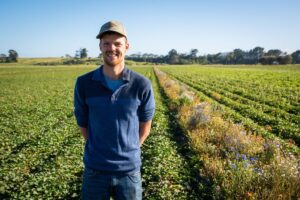
Dargaville kūmara grower Luke Posthuma, one of the biodiversity project grower champions.
At the field walks, growers like Luke are sharing their experiences, lessons learned and regional insights they have gained. Technical advisors to the project will also be present to answer questions.
More information the biodiversity planting project will be shared at the Vegetable Research Roadshow events being held regionally in April and May. Hosted by Vegetables NZ and Vegetable Research & Innovation, and supported by ALT, the roadshow will visit Pukekohe, Gisborne and Hawke’s Bay in April, and Levin, Ohakune, and Ashburton in May. More information and registration details are available here.
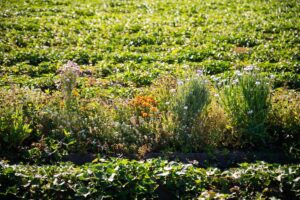
An annual flower strip at Luke’s Dargaville farm.
Learn more about the ALT-VNZ-ONZ biodiversity project here, and find resources, such as how to guides on cover crops, and mobile insectaries on the resources page by selecting ‘Biodiversity’ in the drop down menu.
