
The collaboration and capability benefits from A Lighter Touch are “major and durable”, persisting beyond the life of ALT and underpinning long-term benefits, according to a new report.
The economic analysis of the value of the A Lighter Touch programme has been undertaken by the New Zealand Institute of Economic Research (NZIER), drawing on data collected from interviews with 18 ALT stakeholders in New Zealand’s arable, horticulture and viticulture sectors.
NZIER says in its report stakeholders are clear, the majority of benefits from ALT will occur after the programme ends in 2027, as biologicals, systems approaches, and regulatory pathways mature and are adopted at scale.
In calculating the financial value the programme can deliver to New Zealand growers, NZIER compared three plausible outcomes resulting from the $27 million investment by industry and government in the A Lighter Touch programme. Under each outcome, the value the programme delivers varied depending on the degree of grower adoption of agroecological crop protection practices.
Following interviews with ALT stakeholders, NZIER determined that at this stage the most likely outcome was that by 2032, one in four growers would have made the shift from agrichemical reliance to more integrated practices, delivering benefit valued at approximately $92 million to $103 million (2025 dollars) until 2032.

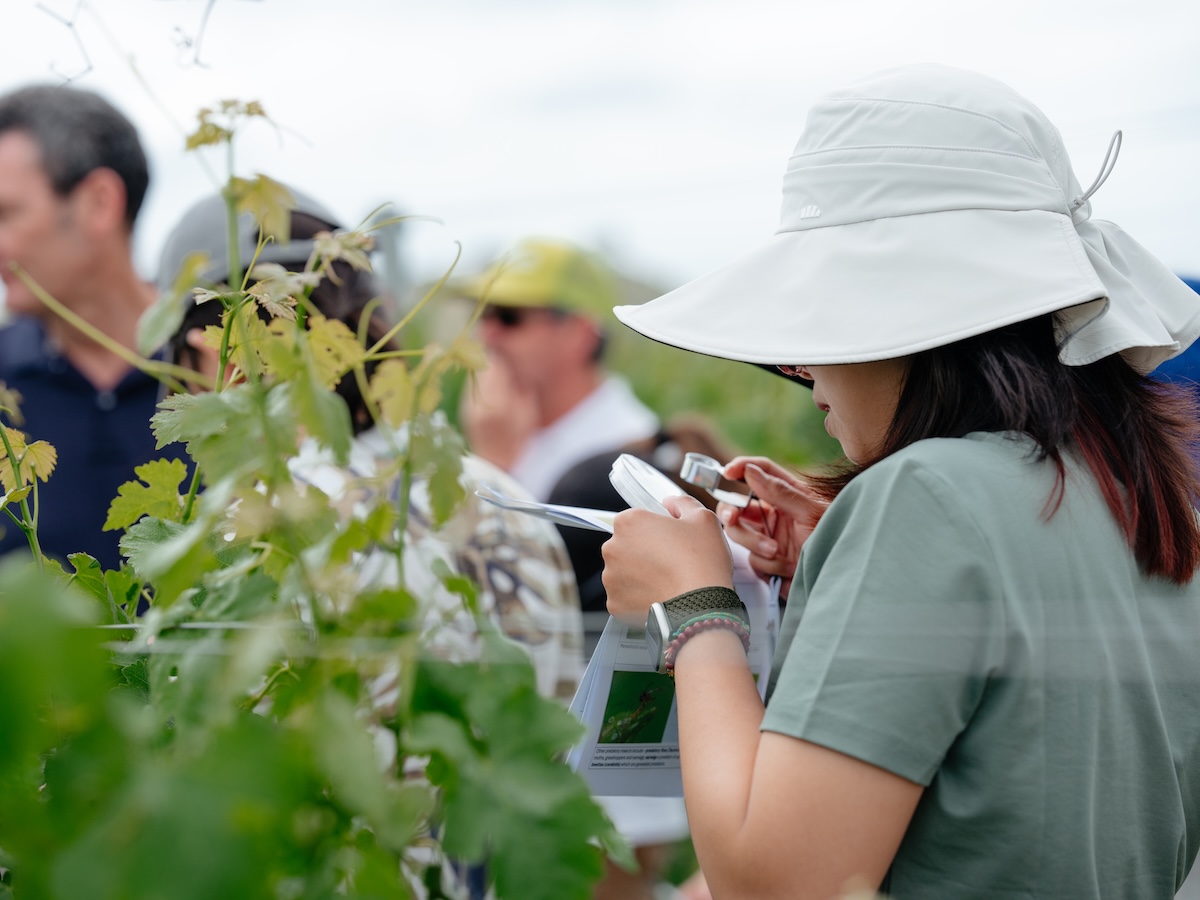
Scouting for beneficial and pest insects during a Summerfruit NZ-ALT field walk.
MPI Manager of Investment Programmes Neil Williams says the economic analysis undertaken by NZIER shows the government’s co-investment of almost $11 million in A Lighter Touch is money well spent.
“MPI’s action plan is to grow the food and fibre sector. We want to double the value of exports by 2034, and we know that achieving that requires strong partnerships between government and industry. The benefits A Lighter Touch is delivering to the horticulture, arable and viticulture sectors demonstrate the value of collaboration for growers and for our economy. It’s a shared success, win-win partnership that aligns with our focus on supporting growth in farm gate exports for the benefit of all New Zealanders.”
Speaking on behalf of the industry investors in A Lighter Touch, Industry Stakeholder Advisory Group chair Dr Sally Anderson says NZIER’s examination of the programme endorses the benefits of collaboration to address common challenges for crop protection within the horticultural, viticulture and arable sectors.
“Co-investment from industry and government in ALT has enabled the sector as a united group to address many of these significant challenges such as access to new crop protection tools and the developing threat of resistance. As NZIER noted in their report, the ALT programme ‘builds a portfolio of future tools’ and the capability for the sector to use these tools. This positions the sector well to address future uncertainties and challenging growing conditions.”
The three outcomes NZIER has modelled are:
- A successful ALT programme:
- As agroecological crop protection becomes embedded in production systems, enabling systematic reductions in chemical use and more robust IPM.
- Take-up rates are assumed to be 50 percent by 2032
- Cumulative present value benefits are estimated between $246 million and $1,231 million (2025 dollars) until 2032.
- Buying an option:
- ALT creates capability, trials and tools that can be drawn on as regulation and markets tighten.
- Take-up rates are assumed to be 25 percent by 2032
- Indicative valuations range from approximately $92 million to $103 million (2025 dollars) until 2032.
- Low degree of success, with growers largely maintaining current practices:
- In some cases, administrative and participation costs outweigh benefits
- Take-up rates are assumed to be 10 percent by 2032
- Benefits range between $17 million and $27 million.
In its report, NZIER says ALT operates in a context of high uncertainty in terms of factors such as regulation, chemistry loss, and buyer behaviour. As such, ALT is viewed by many stakeholders as akin to an insurance policy.
“ALT effectively buys an option for participating sectors in the face of uncertainty, by building a portfolio of future tools (biologicals, softer chemistries, cultural and systems approaches) and the capability to deploy them when needed,” the report says.
The collaborative model of ALT was a consistent theme in the report, described as “novel and uniquely valuable,” creating opportunities that would not have been possible through individual product group investment, the report says.
The cultural shift towards openness, shared learning and joint problem ownership was identified by several interviewees as one of ALT’s most enduring legacies. However, the success of the programme ultimately hinges on capability building within product groups, especially the upskilling of growers. Growers are the point of adoption, and without sufficient capability, the knowledge and tools developed through ALT will not translate into meaningful changes in practice or outcomes.
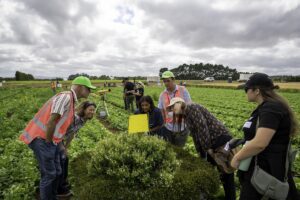
Attendees at the Vegetables Big Day Out inspect a mobile insectary, a component of a biodiversity project demonstrated at the Pukekohe Research and Demonstration Farm.
The interviewees acknowledged that some benefits were delayed due to the nature of agroecological transition, and the substantive impact on grower practice and regulatory approval and market outcomes will not be realised in the programme’s current timeframe.
For smaller product groups, ALT has materially lifted capability, for example improving technical literacy, understanding of regulatory pathways, and confidence engaging with scientific providers. While these smaller groups may face higher costs to participate, they gain access to shared tools they could not fund individually.
The report says larger groups are leveraging ALT alongside their own research, gaining risk reduction and coordination benefits to accelerate learning and results.
When A Lighter Touch was set up in 2020, NZIER estimated the economic benefits to New Zealand resulting from the programme would range from $546 million to $1,528 million per annum by 2027. The 2020 estimates were based on forecast year-on-year growth in the horticulture sector of 7%. In reality growth of the sector has been 4% and therefore calculations of the economic impact ALT has delivered has been revised to reflect the actual growth.
In addition to the NZIER report, further evaluation of ALT’s impact has been undertaken by monitoring and evaluation specialists Scarlatti. It found nine out of ten growers surveyed about their crop protection practices are already integrating agroecological crop protection elements into their pest, disease and weed management.
Further evaluation of ALT’s impact is being undertaken by the Bioeconomy Science Institute (BSI), which is analysing crop protection trends in the industry.
