
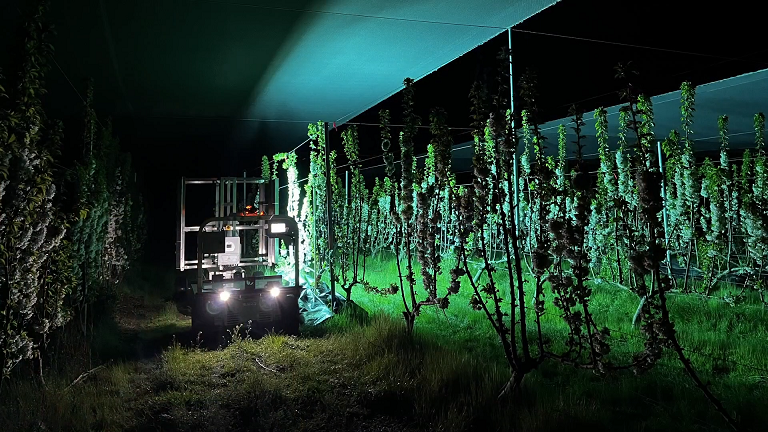
A second trial of ultraviolet light technology to combat fungal diseases in cherries will build on first year findings and grow understanding of its efficacy as a disease management tool.
Last summer the A Lighter Touch-Summerfruit NZ project assessed UV-C light treatment in a cherry orchard for control of Monilinia fruticola (Brown rot), Botrytis cinerea and Pseudomonas syringae pv. syringae (Pss), (Bacterial canker).
Bioeconomy Science Institute (BSI), Plant & Food Research group, conducted the trial last season and will also undertake the coming season’s work. The first year results found the technology showed promise as a new, spray-free, sustainable tool for cherry disease management, but further research was needed under natural disease pressure conditions to confirm efficacy.
In the first season BSI conducted the trial by directly exposing petri-plates with a known concentration of pathogens of the three cherry diseases. The plates were set up on poles in the cherry orchard and an electric Burro autonomous mobile robot, coupled with a UVEXTM UV-C system, deployed the UV-C treatment at night at two light levels, 200 and 500 Joules/m2.

Duplicate plates of a known concentration of Botrytis cinerea and Monilinia fructicola spores and cells/mL of Pseudomonas syringae pv. syringae set up on poles at the orchard site in Cromwell in 2024.
Results showed that Pss and brown rot were highly sensitive to the UV-C doses but Botrytis cinerea was less sensitive to UV-C. There was no effect on pollen viability, however some leaf damage was observed with the repeated 500 Joules/m² dose.
In the second year, the same technology will be used, but this time under natural disease conditions. The 500 Joules/m2 light level will be removed, with the treatment being applied at 200 Joules/m2, as well as a nil control treatment.
In addition to providing data on the efficacy of the UV-C against natural infections of the three diseases, the project will also assess the effects of UV-C on pollen viability, tree health, fruit yield and quality.
Insights from growers and suppliers into the practicalities of implementing the UV-C treatment on orchard will also be collated. The field trial is again being conducted at Cromwell orchard 45 South Cherries, and the project is being supported by Agri Automation (NZ) Ltd and Vertex UV Ltd through the supply of technology, technical expertise and on-orchard support.
The UV-C technology has also been trialled in wine grapes as part of an A Lighter Touch- Bragato Research Institute (BRI) project for control of powdery mildew, with the aim of halving fungicide applications for the disease.
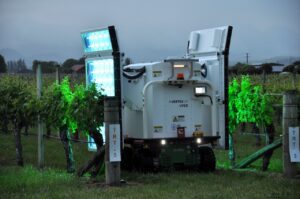
BRI UV-C treatment trial in wine grapes.
BRI and Summerfruit NZ have been sharing learnings from their first-year results. The findings from both cherries and winegrapes are of interest to other ALT stakeholders, including berry growers who are looking to this technology to help reduce agrichemical applications in their crops.
Read more about the UV-C light treatment in summerfruit on the project page, and the wine grapes project here.
