

A grower fact sheet on use of predatory mites for spinach crown mite control has resulted from a Vegetables NZ-A Lighter Touch project evaluating biocontrol options for the pest.
Spinach crown mite (SCM) (Tyrophagus similis) can cause considerable damage to the leaves of spinach plants, reducing marketability and yield.
The two biocontrol agents (BCAs) Neoseiulus cucumeris and Stratiolaelaps scimitus were tested in a laboratory to understand if they can feed and reproduce on SCM and how much they can predate each day.
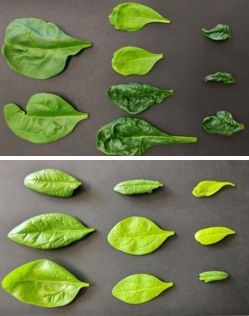
Spinach damaged by spinach crown mite (top), and spinach harvested from trial when two predatory mites (biocontrol agents) were introduced (bottom image).
The second stage of the project was testing the efficacy of the BCAs under greenhouse conditions. Both research activities were undertaken by Bioeconomy Science Institute – Maiangi Taiao in Auckland.
The results showed combining the two commercially available BCAs delivered dual-zone effective pest control, with Neoseiulus cucumeris active on the foliage and Stratiolaelaps scimitus in the soil. When combined, they provided better control than used alone, even if single BCA use delivered significant SCM control under trial conditions.
Preventive releases of the BCAs at early pest establishment were found to prevent SCM outbreaks far better than reactive rescue treatments.
While currently SCM is only a sporadic issue in crops grown outdoors in New Zealand, the industry is moving towards more covered cropping. It is anticipated that SCM may become a pest in greenhouse environments where conditions such as warmth, humidity and reduced light intensity can favour pest population growth.
The project findings have been summarised in a fact sheet along with an explanation of how the predator mites work, and practical recommendations for growers to follow when using predatory mites for pest control.
Download the fact sheet on biological control of spinach crown mite.
