
New Zealand growers would benefit from access to innovative products that support a shift to ‘lighter touch’ crop protection, combat resistance and help meet export market requirements.
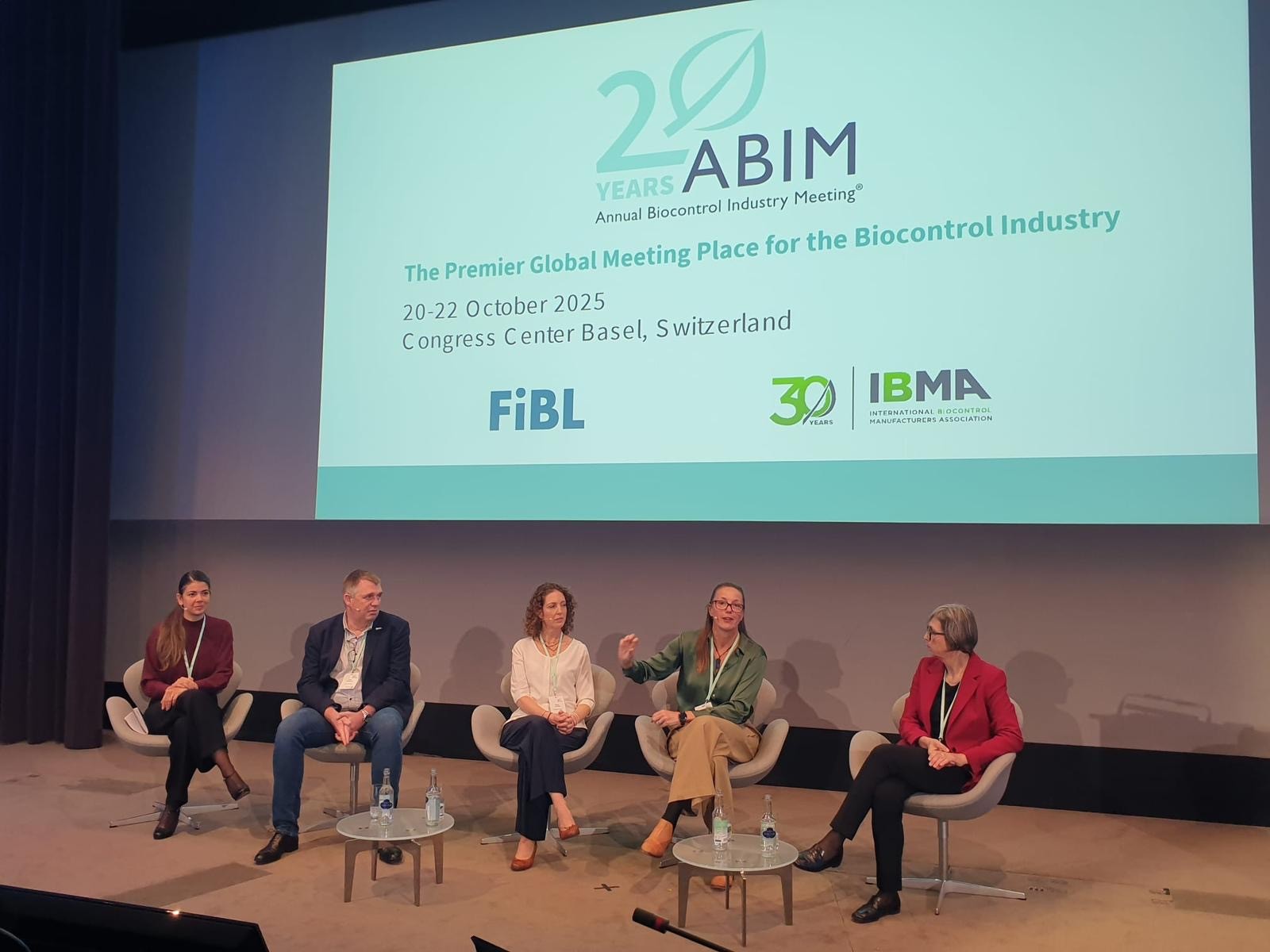
That was the take home message for A Lighter Touch programme director Livia Esterhazy who attended the Annual Biological International Meeting (ABIM) Conference in Basel, Switzerland, late last year.
Livia was invited to present about A Lighter Touch at ABIM, which was attended by 2051 delegates from 65 countries, discussing the latest developments and future trends in sustainable agriculture.
“Globally the biologicals market continues to grow, and it was clear from the range of innovative products presented at ABIM, we simply don’t have enough access to biocontrols that could make a huge different to our growers, their crops and their businesses,” she says.
ABIM is internationally recognised as the place to discover and unveil new biocontrol products, and Livia says some amazing innovations were presented. “Unfortunately, very few are coming to New Zealand and that is giving growers in other countries a competitive advantage.”
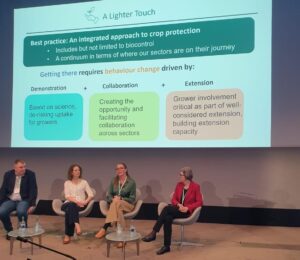
Livia shared lessons from the A Lighter Touch Programme at the conference.
Livia says it was also clear it is not just New Zealand that is negotiating challenges with the regulatory pathway. “Globally it is also complex. Not one country has the full answer, but many are looking towards more of a specific biocontrol regulatory pathway.”
Regulatory approaches being considered in other countries include scope for emergency approvals for biocontrols and a policy of one approval for life, with no reassessment required for biocontrols.
Like New Zealand, a lack of biocontrol capability within regulators is a limiting factor in most countries given decades of focus on processing agrichemical registrations. This means there is simply less expertise available globally to assess biological products compared to agrichemicals, Livia says. This in turn constrains many regulators in terms of their capacity to process new applications, and results in extended timelines for registration.
“The difference for other countries is that the potential market size makes the registration wait worthwhile for the crop protection companies, whereas New Zealand is simply too small a market. This is a real risk for our plant production sector.”
The global growth in biological products as part of an integrated approach to crop protection was demonstrated by statistics shared by industrial market researchers Kline & Company, valuing the current global market for biopesticides alone at USD$7Bn.
The challenges New Zealand growers face that drove the inception of A Lighter Touch, such as developing resistance and meeting market access requirements, are similarly being experienced globally. Delegates from other countries were interested to learn about the ALT programme itself and the collaboration it has supported across sectors, industry, science and Government, Livia says.
“The cross-sector collaboration we have achieved through A Lighter Touch was particularly intriguing, as it was something many larger countries would struggle to achieve.”
The panel discussion where Livia presented focused on demonstrating and upscaling biocontrol. She discussed behaviour change as a key ingredient in encouraging greater adoption of biological products, a message that resonated strongly.
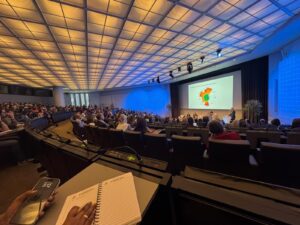
Delegates from 65 countries attended ABIM to discuss developments and trends in sustainable agriculture.
Effective knowledge sharing with growers was discussed in almost all presentations, with strongly coordinated extension seen as a critical factor, rather than relying soley on companies selling their product. It was found that there were still many products with questionable efficacy being promoted to growers, which diluted their trust in other efficacious biological products.
Government support and regulatory efficiency were also seen as key avenues to scale biocontrol, and this was demonstrated at the conference with the European Commission announcing more funding to address regulatory capacity issues, particularly for biocontrol for the European Union member states.
A range of new biologicals were showcased at ABIM, including AXPERA, an amoeba lysate-based biofungicide for combating fungal diseases of concern to ALT sectors, such as downy and powdery mildew in vegetables and grapes, late blight in tomatoes and yellow rust in cereals. It was awarded biocontrol solution of the year at the conference.
