

Advance planning is essential in sourcing the right plants to achieve pest management benefits through introducing native biodiversity on farm and orchard.
Native plants are used in both permanent planting of non-cropping areas and in mobile insectaries as part of the A Lighter Touch-Vegetables New Zealand-Onions New Zealand biodiversity project at the Pukekohe Research and Demonstration Farm.
The project aims to demonstrate increasing plant biodiversity on vegetable farms can result in more beneficial species, fewer pests in crops, and less pesticides required.
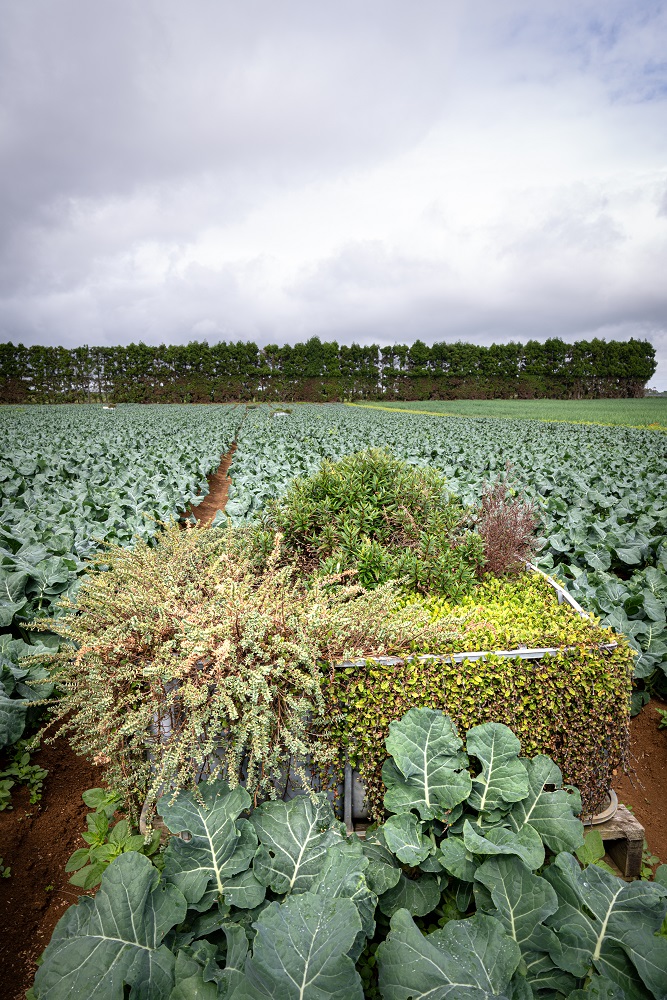
Along with perennial native strips, annual flower strips and cover crops, mobile insectaries are another component of the biodiversity project at the Pukekohe Research and Demonstration Farm.
Olivia Prouse is the biodiversity project lead at the demonstration farm, and selects plant species for farm biodiversity plans to support pollinators, natural enemies and long-term ecological resilience.
She works closely with native plant nurseries to integrate regionally adapted and threatened species alongside commonly used varieties. “These partnerships ensure planting decisions strengthen whole-farm biological function, not just landscape aesthetics.
Sourcing the species of natives required for pest management benefits can be harder than finding the normal revegetation species, and it pays to discuss your plans with nurseries well in advance of when the plants are required, she says.
“Not all nurseries deal in species outside of the main revegetation species, so we are often requiring plants that are a bit harder to find. That said, we’ve found several nurseries who are able to help provide suitable stock and will work with us to source a wider range of species,” Olivia says.
One such nursery is River Road Nursery at Tuakau, North Waikato. Owner Hayley Graham supplied native plants for the mobile insectaries at the demonstration farm, and for permanent native strips planted alongside cropping land by Pukekohe vegetable growers AS Wilcox to help bring beneficial predators into the crops.
River Road grows its own plants as well as sourcing elsewhere, and Hayley says when a customer has specific benefits they are seeking from plant selection, often the most challenging aspect is the time required to find the diversity of plants required.
“If it’s not a species we already stock or grow, we’re happy to help the customer find it, as we can source from a number of different growers, we just need the time to do so.”
As a nursery owner, Hayley says the beauty of working on projects like these is that they create the opportunity to source extra plants which can then be offered to home gardeners, plants that bring greater biodiversity to the garden, beyond just planting for
amenity.
She is seeing growing awareness and interest in the benefits of increasing biodiversity through planting natives, whether its supporting pest management, pollination, reducing soil sediment or for conservation benefits.
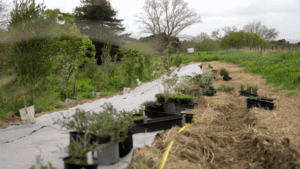
Pukekohe based growers AS Wilcox native perennial plant strip, with grey wool mat used for weed suppression.
For Plant Hawke’s Bay nursery managing director Marie Taylor, bringing back biodiversity to revitalise the local environment is at the heart of their business. She is passionate about the impact of biodiversity, noting the essential role it plays in food security through providing genetic resources for diverse, resilient, and adaptable food systems.
Plant Hawke’s Bay works with local landowners, farmers, communities and councils, and their speciality is eco-sourced seeds and plants, cultivated for the Hawke’s Bay area and nurtured to grow into healthy, hardy full-grown species.
The nursery supplied many of the plants for mobile insectaries developed by the LandWISE research trial site, which is one of a number grower champion demonstrating components of the ALT-Vegetables NZ-Onions NZ biodiversity project in their own operations. Among the species selected is a native daphne called Pimelea mimosa (Pinātoro), a flowering plant that is endemic to Te Mata Peak.

The native daphne Pimelea mimosa (Pinātoro), which grows natively only on Te Mata Peak. Credit: Alex Dickson.
Marie emphasises the importance of using plants from the area, that are adapted to the local landscape. “For example, in Hawke’s Bay, use Hawke’s Bay plants, there’s a much higher likelihood that they’re going to survive compared to any other plants, because they’re adapted for the sites.”
She advocates working with a reputable nursery with knowledge of the local landscape. “We want our clients’ projects to survive, because we want them coming back and getting enthused about their planting.”
Marie recommends growers wanting to incorporate biodiversity into their farm system do a little bit every year. “Put it into your budget and it becomes a normal part of the farm process that happens every year, which reduces the cost and it reduces the risk.”
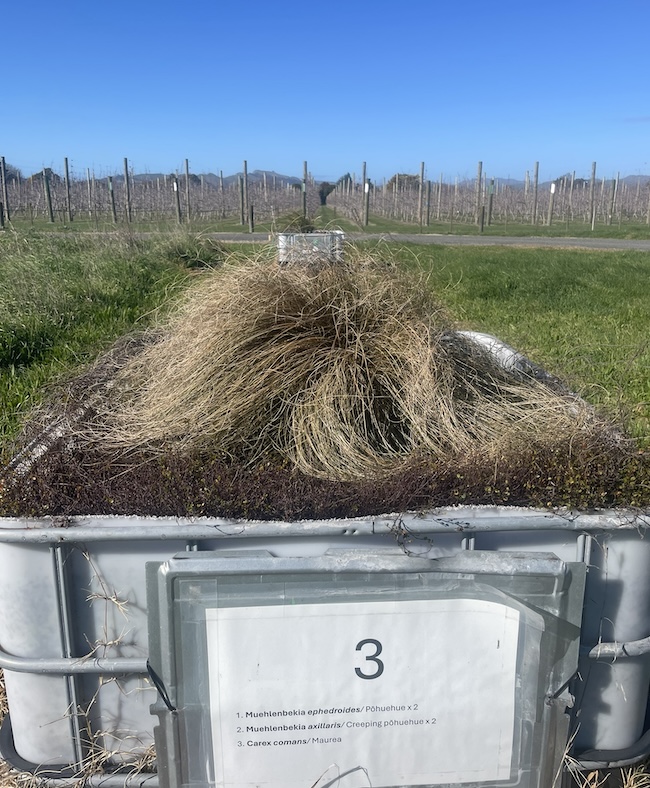
A mobile insectary at the LandWISE research trial site in the Hawke’s Bay. Credit: LandWISE
In Tasman, Keith Roberts, of Titoki Nursery, says they are seeing increasing numbers of farmers incorporating biodiversity planting.
“Some are doing it because they want to be good stewards of the land, to improve it. For others, it’s about environmental and sustainability benefits, whether it’s protecting creeks and rivers with riparian plantings, or supporting pollination and pest management of crops.”
Titoki has helped with revegetation projects across the top of the South Island for over thirty years, preparing plans and programmes, and eco-sourcing the seed to make them happen.
More recently they have worked with local vegetable growers who are looking to reduce their agrichemical use. “Typically, the closer you can take the farm to a normal ecosystem, rather than a monoculture, the less pests and diseases you see,” he says.
Keith says many farmers have a good understanding of what they want to achieve through native planting, and their aim as a nursery is to add that little bit of extra help to support the success of the project.
