

Following successful summer trials of an acoustic caller to lure and trap black field crickets, the Vegetables New Zealand-A Lighter Touch project will this season further refine the new management tool for the kūmara and pasture pest.
The project team will start trapping the pest in spring at the kūmara farm near Dargaville hosting the trials. In addition, some of the captured crickets will be used in mark, release and recapture tests to determine the trap range.
In another aspect of the project, Bioeconomy Science Institute (BSI) are evaluating a biopesticide in the laboratory to determine if it will infect and kill black field cricket (Teleogryllus commodus).
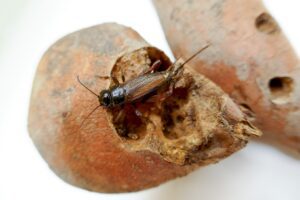
Black field cricket is a damaging pest on kūmara crops.
If effective, the biopesticide could be sprayed on crickets caught in the trap, which could then be released to infect other crickets.
A decision about trap function between ‘lure and kill’ and ‘lure and infect’, will be made and the 3D printed trap may need to be modified to meet the trap function needs.
Black field cricket is a serious pest for vegetables (especially kūmara) and pasture in northern areas of New Zealand. Control options are limited, and the risk of resistance development due to the limited modes of action is high and of concern to growers.
A previous Plant & Food Research AGMARDT-funded study successfully demonstrated the concept of an electronic acoustic caller to attract crickets can work. The VNZ-ALT project is refining the caller and trap combination to maximise trap effectiveness and efficiency.
During one 24-hour period more than 100 female crickets were captured using the trap in the March-April 2026 field tests.

Black field cricket, marked with paint, for a release and recapture test to determine trap range.
BSI scientist and project lead Sophie Hunt initially deployed traps at night using both acoustic caller and light to attract crickets. However, after observing crickets also using the traps as daytime refuge, she expanded monitoring to compare day versus night catches, and ultimately shifted to 24-hour sampling.
Night trials compared four trap treatments: a control trap, a trap with an acoustic caller, a trap with a light source, and a trap combining both the light and caller. Statistically, the addition of the light did not increase catch compared to caller alone, so moving forward only the caller was used to attract crickets.
In the 24-hour monitoring using the caller only, traps averaged 20 female adult crickets were caught and 1-2 adult males per trap. Sophie notes that these averages included nights affected by low temperatures or rainfall, which reduced trap efficiency, while in favourable conditions individual traps sometimes captured more than 100 females in a 24-hour period.
A range of trap types were tested, and a prototype trap was developed before the field trials with a one-way door to target crawling crickets. Once the trap design is finalised, it will be available to growers as open source technology, able to be constructed with a combination of commercially available plastic containers and 3D printed components.

The trap and acoustic caller prototype used in the trials. Credit: BSI
All life stages of the cricket feed on kūmara tubers underground, resulting in damage which can lead to crop losses of $10,000 to $30,000 per hectare depending on market pricing. While complete crop loss is rare, in some cases entire fields can be rendered worthless due to feeding damage.
Learn more on the Control of black field cricket project page.
