
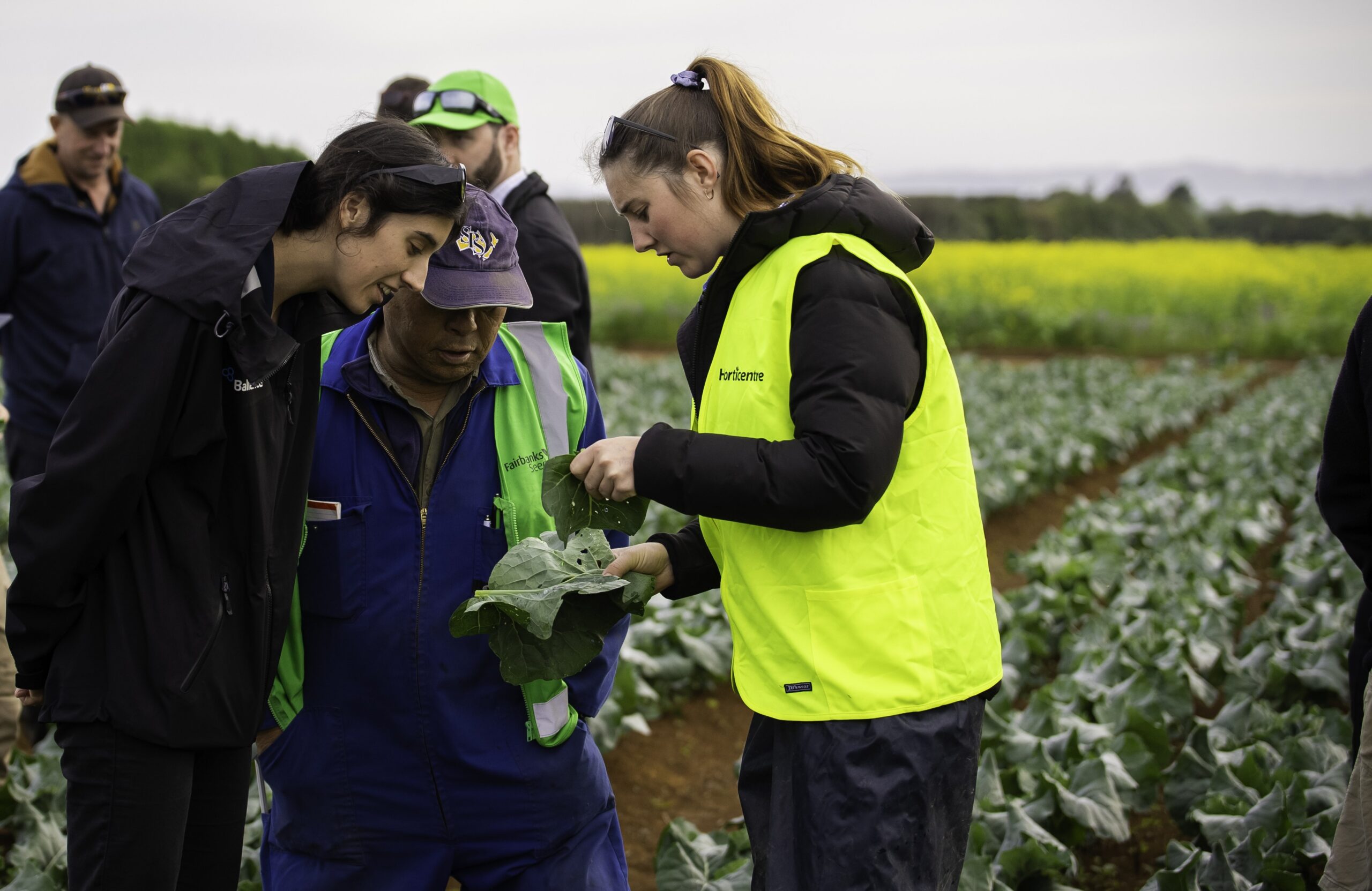
A busy season of trials across multiple crops is planned for the final year of A Lighter Touch projects at the Pukekohe Research and Demonstration Farm.
The Vegetables New Zealand-A Lighter Touch sweet corn trap crop trial is being repeated for a third season, following two years of low green vegetable bug (GVB) pressure which meant it was not possible to conclusively determine the effectiveness of the trap crop strategy. The trial uses a trap crop as a central strategy in an IPM approach targeting green vegetable bug (GVB), a significant crop pest in sweet corn.
The trap crop, made up of species attractive to GVB, is planted around the outside of the sweet corn, with the goal of aligning the flowering and seeding time of the trap crop with the sweet corn crop. When GVB migrates into the crop, the pest encounters the flowering and seeding trap crop first. A non-planted area is maintained as a barrier between the trap crop and the sweet corn to encourage the pest to stay and feed in the trap crop.
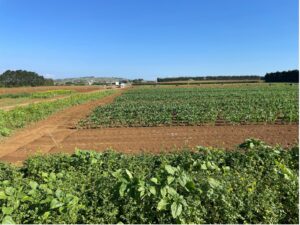
Trial layout showing the trap crop beginning to flower around the perimeter, the bare-soil buffer, and the sweet corn crop in the centre (10 December 2025).
Last season the sweet corn crop was planted at the beginning of November in the hope an earlier planting date would attract greater pest pressure. This season the corn, which follows an oat service crop, is planned for a late October planting. Crop case studies sharing the integration of the trap crops with the sweet corn and the results from the previous two seasons’ trials can be found here.
In the Vegetables New Zealand-Onions New Zealand-ALT biodiversity project, the focus will be on monitoring of the perennial planting to gather evidence of the impact it has in supporting pest management by providing food and shelter for beneficial insects.
This work began last season but was negatively impacted by an accidental spraying of the perennial planting with glyphosate. Affected areas have now been replanted, A spring lettuce crop will be planted beside the perennial native planting. Scientists from the Bioeconomy Science Institute (BSI) will be monitoring both beneficials and pests at intervals across the lettuce, evaluating predation and parasitism of pests in the crop as compared to a standard lettuce crop without biodiversity planting.
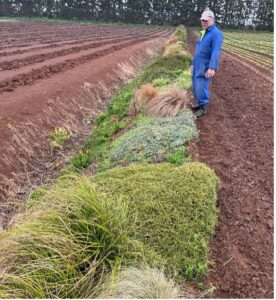
Side drain plantings prior to accidental glyphosate application.
With the focus on validating the impact of the perennial planting, other biodiversity components, such as the annual flower strips and mobile insectary pods will not be implemented as part of pest management in the lettuce crops.
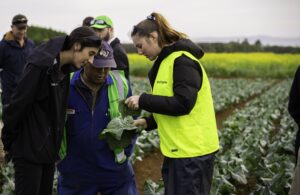
Growers scouting for pests and beneficial insects during a workshop.
A fourth season of educational IPM workshops are being hosted at the farm by Vegetables NZ over an eight-week period, beginning mid-October. Each session begins with a field walk in the spring lettuce, enabling growers and crop protection advisors to scout and discuss next steps in terms of crop management alongside the project team.
A third season of spring barley will be planted, enabling the Foundation for Arable Research (FAR) to demonstrate reduced input spring barley systems for the northern North Island. This season’s barley will follow a cover crop, with half the block being drilled into the cover crop after it has been crimped, and the other half being mulched and cultivated before planting.
The two blocks will be used to enable a comparison of current best practice with a future management approach involving IPM with a focus on reduced agrichemical inputs. Learn more about this project in this video case study.
In the onions block, the focus will be on management of downy mildew using automated spore trapping technology to support better decision-making. The trial will utilize a Bioscout unit, one of three funded by Te Ahikawariki Vegetable Industry Centre of Excellence (VICE), with the support of Vegetables NZ, Onions NZ and Potatoes NZ. A Lighter Touch is supporting the trial by providing land for the onion crop in which disease is being monitored.

Onion crop at the Pukekohe Research and Demonstration Farm. Credit: A. Luxmore
The BioScout unit collects air samples from 2m above ground, taking microscopic images of particles in the air and using artificial intelligence to analyse them to see if they carry disease spores. Last season it was tested as a decision support tool for stemphylium leaf blight (SLB) management in onions, and this season will focus on downy mildew.
In one zone of the trial, information from the BioScout unit will be used to target control when the disease is present, rather than calendar spraying. In a second zone, the crop will be managed with a standard fungicide programme, and a third zone will be an untreated control, where no downy mildew focused products will be used so peaks in disease can be determined, and used for comparison against the BioScout data.
Data from the BioScout unit at the research and demonstration farm and two other units located on commercial growers’ properties will be used to build a picture of how accurately BioScout can predict the disease and whether it can be used for decision-making in downy mildew management.
Updates from all of these projects at the farm will be shared via the ALT newsletter and website.
