

Three years of trial work has highlighted the role biofungicides can play as an additional control tool for brown rot in summerfruit, also contributing to resistance management.
Brown rot (Monilinia fructicola) is a fungal disease in stonefruit that causes blossom blight in spring and fruit rot which can result in significant crop losses. It is currently controlled by multiple spray applications of synthetic fungicides.
Concerns around fungicide resistance, regulatory pressures and the need for more sustainable crop protection options prompted Summerfruit NZ to fund a comprehensive screening programme by the Bioeconomy Science Institute (BSI) seeking effective biological alternatives. Beginning in 2023, researchers evaluated a range of registered biological products through laboratory studies, detached blossom and fruit assays, and potted tree trials.
The four most promising registered products identified through the BSI work were then evaluated via a Summerfruit NZ-A Lighter Touch field trial during the 2025-2026 season.
While all products reduced brown rot incidence at harvest, only two achieved statistically significant reductions. One product delivered the strongest field performance, achieving 75% control of brown rot at harvest, and is a priority candidate for Summerfruit NZ’s future field testing for adoption into a late season brown rot control spray programme.
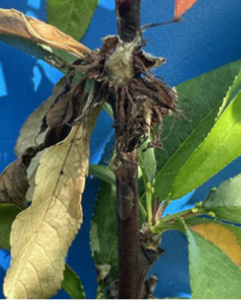
Typical canker, wilted leaf cluster, blighted flower and poor fruit set caused by brown rot on ‘Gordon’s Glory’ peach. Credit: Parry et al. 2026
The trial was conducted in a commercial ‘Golden Queen’ peach orchard in Hawke’s Bay, a variety known for its susceptibility to brown rot. Efficacy of the biofungicides was compared to an unsprayed late season control and the grower’s standard late season fungicide programme.
Four weekly applications of biofungicides were made during February, with harvest in early March. Brown rot was assessed on fruit in the orchard at harvest and in the laboratory after six days of incubation in disease-conducive conditions.
The harvest assessment found all four biofungicides reduced mean brown rot incidence and two biofungicides as well as the standard fungicide programme had significantly fewer infected fruit (mean 2% or less brown rot incidence).
In the post-harvest assessment, none of the biofungicides reduced brown rot incidence as significantly as the standard fungicide programme, which was 93% efficacious. By comparison the two best performing biofungicides did reduce postharvest brown rot significantly and were rated 44% and 31% for efficacy respectively.
Importantly, the trial highlighted the role biofungicides can play in integrated pest and disease management systems. Although the biological products were not as effective as conventional fungicides under the moderately high disease pressure experienced during the trial, they offer valuable additional modes of action that can help reduce reliance on synthetic chemistry and support resistance management strategies.
A recommendation for future work is to focus on biofungicides registered and established for use in other crops such as apples in New Zealand, as these are likely to be readily adopted and available in retailers in stonefruit growing regions.
Find out more on the project page or learn more about the sector’s response to the fungal disease by downloading the resistance management case study on brown rot.
